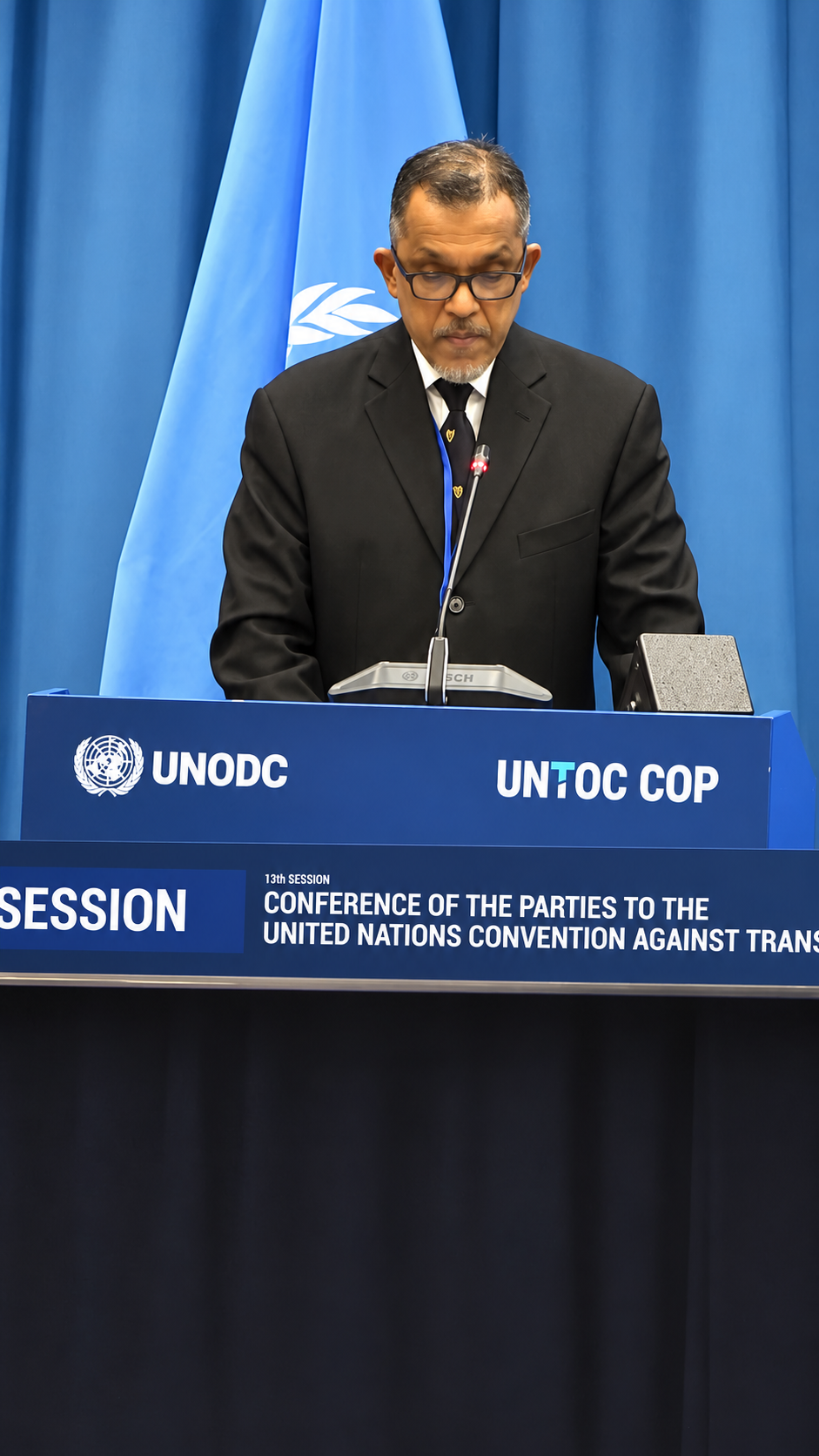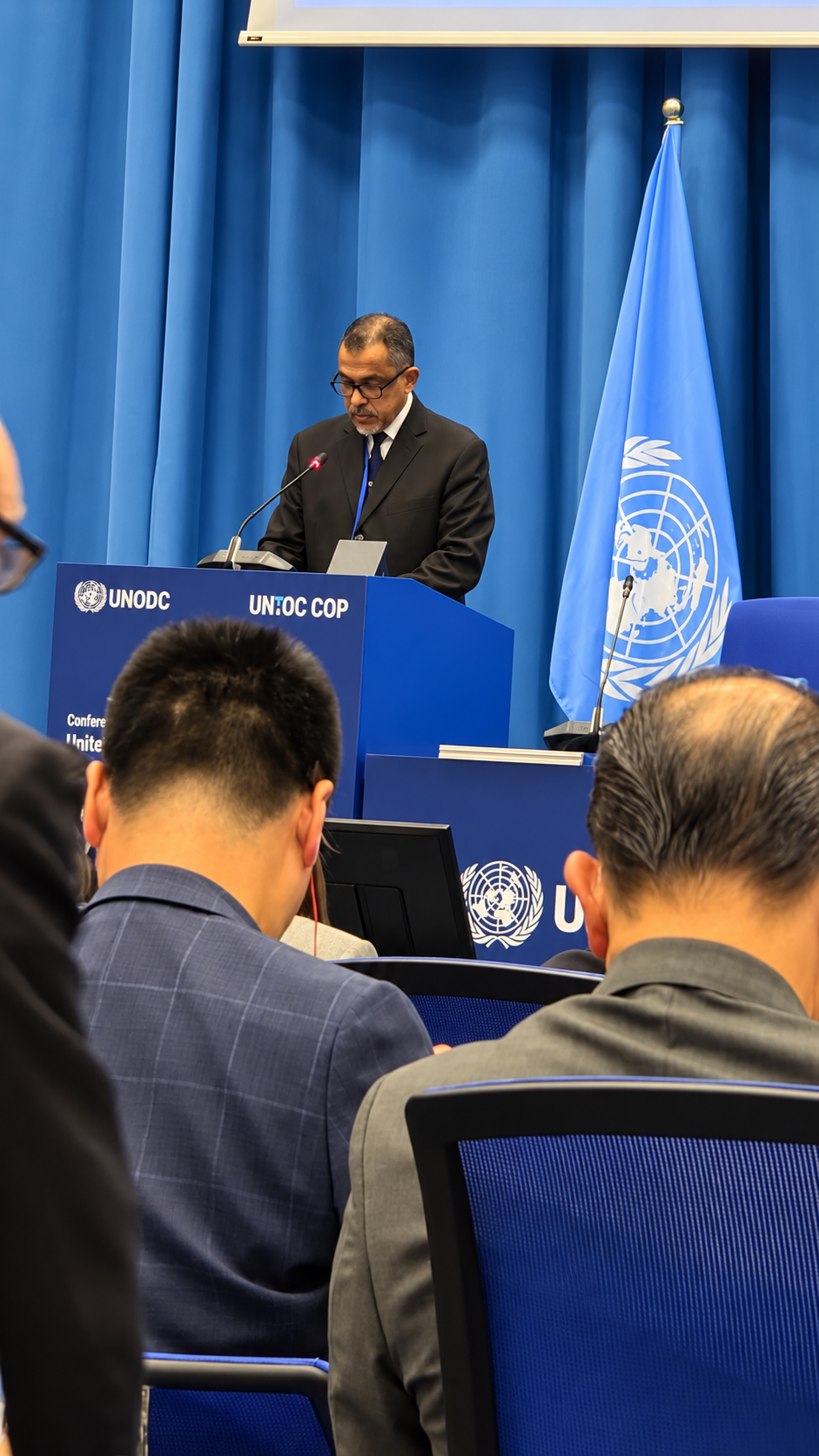
13TH SESSION OF THE CONFERENCE OF THE PARTIES TO THE UNTOC
19 – 23 OCTOBER 2026, VIENNA, AUSTRIA
STATEMENT BY SRI LANKA
Mr. President,
I wish to express my sincere congratulations on your election as President of the 13th Session of the Conference of the Parties to the UNTOC and to the members of the Bureau on their election.
I also thank outgoing President H.E. Peter Burian, Ambassador and Permanent Representative of Slovakia and members of the Bureau on their leadership and commitment over the past two years.
I also congratulate Ms. Monica Juma, Executive Director of the UNODC on her appointment and take this opportunity to thank the Secretariat for the preparations for this Conference.
Mr. President,
Sri Lanka shares the concerns expressed by many delegations on the increase and serious impact of transnational organized crimes on societies. In particular, the exploitation of new and emerging technologies by criminal groups to operate across borders and evade law enforcement, requires our urgent attention. We re-iterate the importance of preventing and combating such crimes through a well-coordinated response at national level and effective international cooperation and acknowledge the important role of the UNTOC in this regard.
As a State Party to the UNTOC and its Protocol to Prevent, Suppress and Punish Trafficking in Persons, Especially Women and Children as well being a signatory to its Protocol Against Smuggling of Migrants by Land, Sea and Air, Sri Lanka has taken significant steps to counter such crimes. The support of UNODC in this respect, through technical assistance, capacity building and training programmes for law enforcement officers, is appreciated.
The increase in numbers of persons trafficked for the purpose of forced criminality is a cause for concern which requires urgent action and cooperation at national and international levels. In Sri Lanka, the National Anti-Human Trafficking Task Force (NATTF) coordinates national efforts with Government institutions responsible for trafficking prevention, victim protection, law enforcement, prosecution and victim assistance.
Sri Lanka has introduced several measures to strengthen its response to human trafficking; including the launch of the National Strategic Action Plan to Monitor and Combat Human Trafficking 2026 - 2030, setting the framework for coordinated action over the next five years, as well as the establishment of seven provincial Anti-Human Trafficking Forums as a specialized coordination mechanisms to identify trafficking risks and strengthen local level responses. Greater attention has also been provided to emerging forms of human trafficking including recruitment through technology and online exploitation. Specialized Training of Trainers (TOT) programmes have been conducted for selected law enforcement officers creating a cadre of certified instructors on Trafficking in Persons (TIP) and Smuggling of Migrants (SOM), as well as for frontline responding officers, creating a cadre of certified inspectors to strengthen first response capacities. The TIP and SOM response mechanisms at the Department of Immigration and Emigration have been strengthened through enhanced capacity-building, specialised training and inter-agency cooperation to improve the identification of suspected cases and facilitate appropriate responses. As a result, Sri Lanka has retained its Tier 2 status in the US Department of States Trafficking in Persons Report 2026, for the fifth consecutive year.
Sri Lanka is also strengthening its response to emerging forms of human trafficking, including trafficking for forced criminality in cyber-scam operations. Such crimes highlight the growing intersection between transnational organized crime and technology-facilitated exploitation. Sri Lanka recognizes the importance of strengthening early identification, victim protection and assistance, and cooperation among relevant national authorities and international partners to address these evolving challenges.
Mr. President
With regard to the smuggling of migrants, Sri Lanka is taking steps to strengthen its legal and operational response. The proposed Immigration Bill represents an important development in this regard. Once enacted by Parliament, it will provide an updated legislative framework for immigration administration and border management. The Bill includes a dedicated chapter on human smuggling, covering offences related to facilitating irregular entry, organizing smuggling activities, aggravated smuggling offences, and documentary offences associated with these activities, It also provides for extraterritorial jurisdiction in relation to specified offences subject to the conditions set out in the proposed legislation.
In this context, with the rapid increase in crimes committed through information and communications technology including online scams and cyber fraud, cooperation at international level is essential. Sri Lanka signed the UN Convention against Cyber Crime in 2025 and is making preparations for its ratification. UNODC’s support in identifying areas for potential legislative reform, institutional strengthening, enhanced mechanisms for cooperation and technical assistance is further appreciated. It has also been proposed to hold a two-day UNODC regional conference focusing on South Asia, in Sri Lanka from 16-17 December 2026 to advance a comprehensive understanding of evolving cybercrime threats and strengthen international cooperation.
Sri Lanka recognises the importance of strengthening maritime domain awareness and information-sharing among relevant agencies to improve the detection, investigation and prosecution of maritime crimes.
Sri Lanka works closely with the Global Maritime Crime Program of UNODC in countering crimes at sea. In 2026, UNODC support assisted Sri Lanka in strengthening maritime drug interdiction and the investigation and prosecution of resulting cases, contributing to major maritime drug interdictions. UNODC support also included a six-week Integrated Training Package on strengthening the full criminal justice response, from boarding and evidence collection at sea to investigation, prosecution and a simulated trial, to promote inter-agency cooperation, lawful procedures and the preservation of evidence needed to bring perpetrators to justice. National and regional consultations will agree on priorities for UNODC - Sri Lanka partnership in 2027. These efforts support the practical implementation of UNTOC by connecting operational action at sea with effective criminal justice responses and cooperation across borders.
Partnership with UNODC on countering the trafficking of drugs include training for frontline officers from Sri Lanka at the UN Narcotics Laboratory in Vienna on drug identification, safe handling, crime scene investigation, as well as the provision of Raman devices, drug kits, and crime scene investigation kits in 2026. Further, the Government Analysts Department has consistently participated in UNODC International collaborative exercises since 2011.
Sri Lanka is also taking measures to counter Illicit Financial Flows (IFFs) including those related to drugs and terrorism offences, with assistance from UNODC. This project is aimed at strengthening capacities to address IFFs, enhancing international cooperation through mutual legal assistance (MLA) and advancing responses to IFFs through regional dialogue.
In February 2026, a national awareness-raising programme and specialized training was provided by UNODC for over 25 officials from the Sri Lanka Police (including the Criminal Investigation Department, Police Narcotics Bureau and National Police Academy), Financial Intelligence Unit, Sri Lanka Customs, and National Dangerous Drugs Control Board. Participants enhanced their understanding of drug-related illicit financial flows, associated terrorism financing risks, asset recovery, financial intelligence, parallel financial investigations, and emerging criminal methodologies, including the use of crypto-assets. The activities also helped identify priorities for stronger inter-agency cooperation and future capacity-building support.
Sri Lanka emphasises that effectively combating transnational organized crime requires not only the investigation and prosecution of offenders but also efforts to trace, freeze and confiscate the proceeds of crime in accordance with applicable domestic law. Strengthening international cooperation, including through mutual legal assistance and the exchange of relevant financial intelligence, is essential to addressing the cross-border dimensions of illicit financial flows and preventing criminal networks from benefiting from their activities.
Sri Lanka reaffirms its commitment to the effective implementation of the UNTOC and its relevant Protocols, and to strengthening international cooperation in preventing and combating transnational organized crime. Sri Lanka will continue to work with UNODC and other Member States to address evolving criminal threats through enhanced national capacities, coordinated responses and practical international cooperation.